
The short version
- 2,330 tariff lines carry CESS today, under the CESS Order made in March 2026 under section 14 of the Sri Lanka Export Development Act, No. 40 of 1979. It took effect on 1 April 2026.
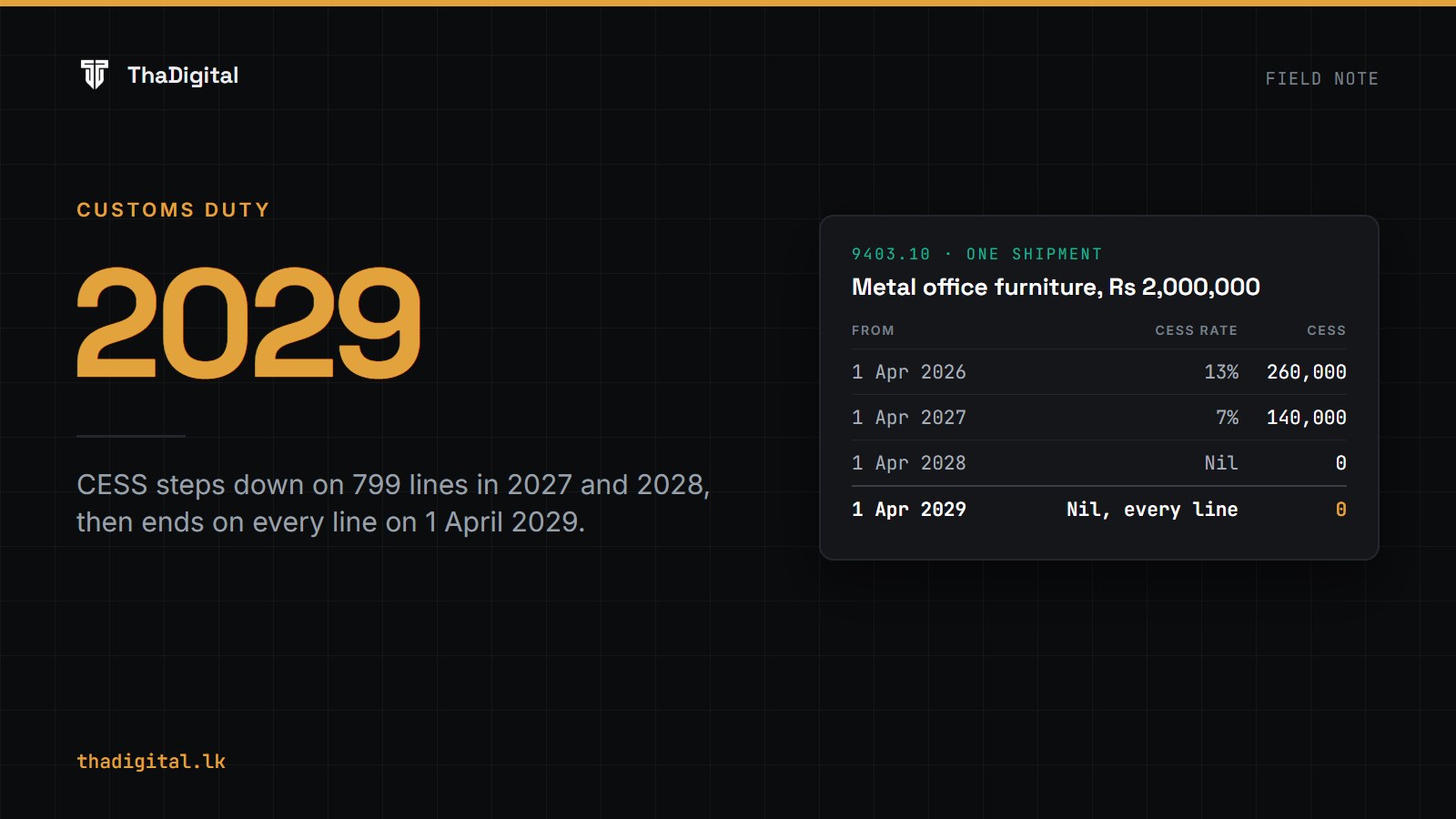
- 1 April 2027: CESS steps down on 799 of those lines.
- 1 April 2028: the same 799 lines step down again, and on 688 of them it reaches nil.
- 1 April 2029: CESS ends on every line.
- The other 1,531 lines keep today’s rate until 31 March 2029, then end.
The Order sets all four years at once. The national tariff guide prints only the first, so a duty sheet copied from the guide will be wrong from 1 April 2027 on about a third of the lines that carry CESS.
One order, four columns
Schedule A of the Order gives every line four rates, one for each period:
| Column | In force |
|---|---|
| IV | 1 April 2026 to 31 March 2027, the rate the tariff guide prints |
| V | 1 April 2027 to 31 March 2028 |
| VI | 1 April 2028 to 31 March 2029 |
| VII | From 1 April 2029: nil on every line |
From 1 April 2026 it replaced the earlier CESS orders in Gazettes 2325/06, 2341/63 and 2478/04, and the first clause of 2400/25.
What it looks like on goods you know
| Goods | Today | 1 Apr 2027 | 1 Apr 2028 | 1 Apr 2029 |
|---|---|---|---|---|
| Metal office furniture, 9403.10 | 13% | 7% | Nil | Nil |
| Other metal furniture, 9403.20 | 13% | 7% | Nil | Nil |
| New car tyres, 4011.10.90 | 25% or Rs 330/kg | 19% or Rs 248/kg | 13% or Rs 165/kg | Nil |
| Plastic tableware and kitchenware, 3924.10 | 30% or Rs 300/kg | 30% or Rs 300/kg | 30% or Rs 300/kg | Nil |
| Ceramic tableware, 6911.10 | 10% or Rs 120/kg | 10% or Rs 120/kg | 10% or Rs 120/kg | Nil |
| Drinking glasses, 7013.37 | 10% or Rs 90/kg | 10% or Rs 90/kg | 10% or Rs 90/kg | Nil |
| Rubber or plastic slippers, 6402.20 | Rs 700/pair | Rs 700/pair | Rs 700/pair | Nil |
| Fresh oranges, 0805.10.10 | 10% | 10% | 10% | Nil |
Two shapes, then. Some lines step down each April and are gone by 2028. Most hold their rate for three years and drop to nil in one go on 1 April 2029.
Two rates on one line
More than 600 lines carry two rates, such as “30% or Rs 300 per kg”. The Order’s own proviso settles which: where more than one rate is given, the one that gives the higher CESS applies. Where a line steps down, both parts step down together, so work both out again for each period.
1,000 kg of plastic kitchenware with a customs value of Rs 1,200,000: 30% is Rs 360,000, and Rs 300 a kg is Rs 300,000. The CESS charged is Rs 360,000.
A CESS cut is worth more than the CESS
VAT and SSCL are charged on 110% of the customs value plus the duties already on the line, and CESS is one of them. So every rupee of CESS also carries 18 cents of VAT and 2.5 cents of SSCL. At today’s rates, taking Rs 100 of CESS off a line takes about Rs 120.50 off the total.
The same kitchenware, today and from 1 April 2029, with every other rate as it is now:
| Tax | Today | From 1 Apr 2029 |
|---|---|---|
| CID 20% or Rs 75/kg | 240,000 | 240,000 |
| PAL 10% | 120,000 | 120,000 |
| CESS | 360,000 | 0 |
| VAT 18% | 367,200 | 302,400 |
| SSCL 2.5% | 51,000 | 42,000 |
| Total | 1,138,200 | 704,400 |
The CESS was Rs 360,000. The total falls by Rs 433,800. CID, PAL, VAT and SSCL can each change by a gazette of their own, so treat any figure for 2029 as today’s best estimate.
The date decides
An entry is assessed under the tariff in force on its date. Two identical shipments of metal office furniture, customs value Rs 2,000,000 each, one declared on 31 March 2027 and one on 1 April 2027:
| Tax | 31 Mar 2027 | 1 Apr 2027 | 1 Apr 2028 |
|---|---|---|---|
| CID 20% and PAL 10% | 600,000 | 600,000 | 600,000 |
| CESS | 260,000 | 140,000 | 0 |
| VAT 18% | 550,800 | 529,200 | 504,000 |
| SSCL 2.5% | 76,500 | 73,500 | 70,000 |
| Total | 1,487,300 | 1,342,700 | 1,174,000 |
One day apart, Rs 144,600 apart. When a shipment lands close to 1 April, agree with the importer which date the estimate assumes, and confirm the date that applies before you quote a final figure.
Before 1 April 2027
- Agencies: do not carry last year’s duty sheet forward. Take the column for the entry’s date, not the rate the guide prints.
- Quotations for goods arriving near a change date: show the duty for both dates, or say which date the figure assumes.
- Importers: landed costs on CESS lines change every 1 April until 2029. A price list built on today’s duty will drift.
- Keep an eye on the gazette: the Order can be amended like any other. The rate that counts is the one in force on the entry’s date.
Where these figures come from
Every rate here is read from Schedule A of the CESS Order, all four columns, line by line, as published by Sri Lanka Customs. The counts are tariff lines in that schedule. The shipments are invented; the rates are the Order’s. This note is general information, not a ruling: Customs’ assessment is the final word.
Quick answers
When does CESS end in Sri Lanka?
On 1 April 2029, on every tariff line, under the CESS Order of March 2026. Until then each line carries the rate the Order sets for that year.
Which goods have a lower CESS from 1 April 2027?
799 tariff lines, among them metal furniture (13% to 7%) and car tyres (25% or Rs 330 a kg to 19% or Rs 248 a kg). The other 1,531 lines keep their rate until 31 March 2029.
Is VAT charged on CESS?
Yes. VAT and SSCL on imports are charged on 110% of the customs value plus CID, PAL and CESS, and excise and surcharge where they apply. A lower CESS lowers VAT and SSCL too.
Which rate applies to a shipment near 1 April?
The rate in force on the entry's date. Confirm the date that applies before you quote a final figure.
How ClearWay handles it
ClearWay carries all four columns on every line. A job is charged the CESS of its own date, and the tax working says which column it used, for example “this rate from 1 April 2027 to 31 March 2028 (column V)”. The Tariff screen shows a code’s later years before you quote. It is free to try on your own Windows PC.