
A place to lodge, not a place to work
CusDec I has 54 cages. In ASYCUDA World the items are added one at a time, coded fields are filled from ASYCUDA's own lists, and every figure has to be right before the entry is assessed. It is a national system, shared by every agency in the country, and reached over a secure connection. Customs has said publicly that it runs close to its capacity, and on a busy day that shows.
Since 1 October 2026 there is no paper to fall back on. Every CusDec now goes in through ASYCUDA with digitally signed copies of its supporting documents, and declarations made the old way are no longer accepted.
None of that makes ASYCUDA a bad system. It makes it the wrong place to think.
What a wrong cage costs
Customs' own training for agents is plain about it:
| The slip | What follows |
|---|---|
| Wrong office code, or wrong model of declaration | The CusDec has to be cancelled |
| Wrong BL number | Written off, and the CusDec may be cancelled |
| Importer TIN that does not tally with the invoice, DO or BL | Penalties |
| Wrong vessel name | Penalties |
| Wrong currency code | Loss of revenue, and the questions that come with it |
| Package total that does not agree with the items | Customs requires the two to agree |
| A zero in a container's empty weight or package count | Trouble at the exit note |
| Exporter name and address longer than ASYCUDA's space | A blank on the printout, and an amendment |
Every one of these is caught more cheaply before the entry reaches ASYCUDA than after.
Why the trade frames the entry first
Framing means working the whole entry out before it goes near the live system: the codes, the values, the weights, the packages and the duty, checked against the supplier's own documents. The trade has always done it, in a notebook, a spreadsheet, or an older framing program.
It works, but it carries two weaknesses that cost agencies every day.
- Retyping. A forty-line invoice is forty items, each with a dozen cages. Everything worked out in the frame is typed again into ASYCUDA, and every one of those keystrokes is a chance to swap two digits.
- Drift. A late correction goes into ASYCUDA but not into the frame, or the other way round. By the time the assessment arrives, the papers on file no longer describe the entry that was lodged.
Frame once, type nothing twice
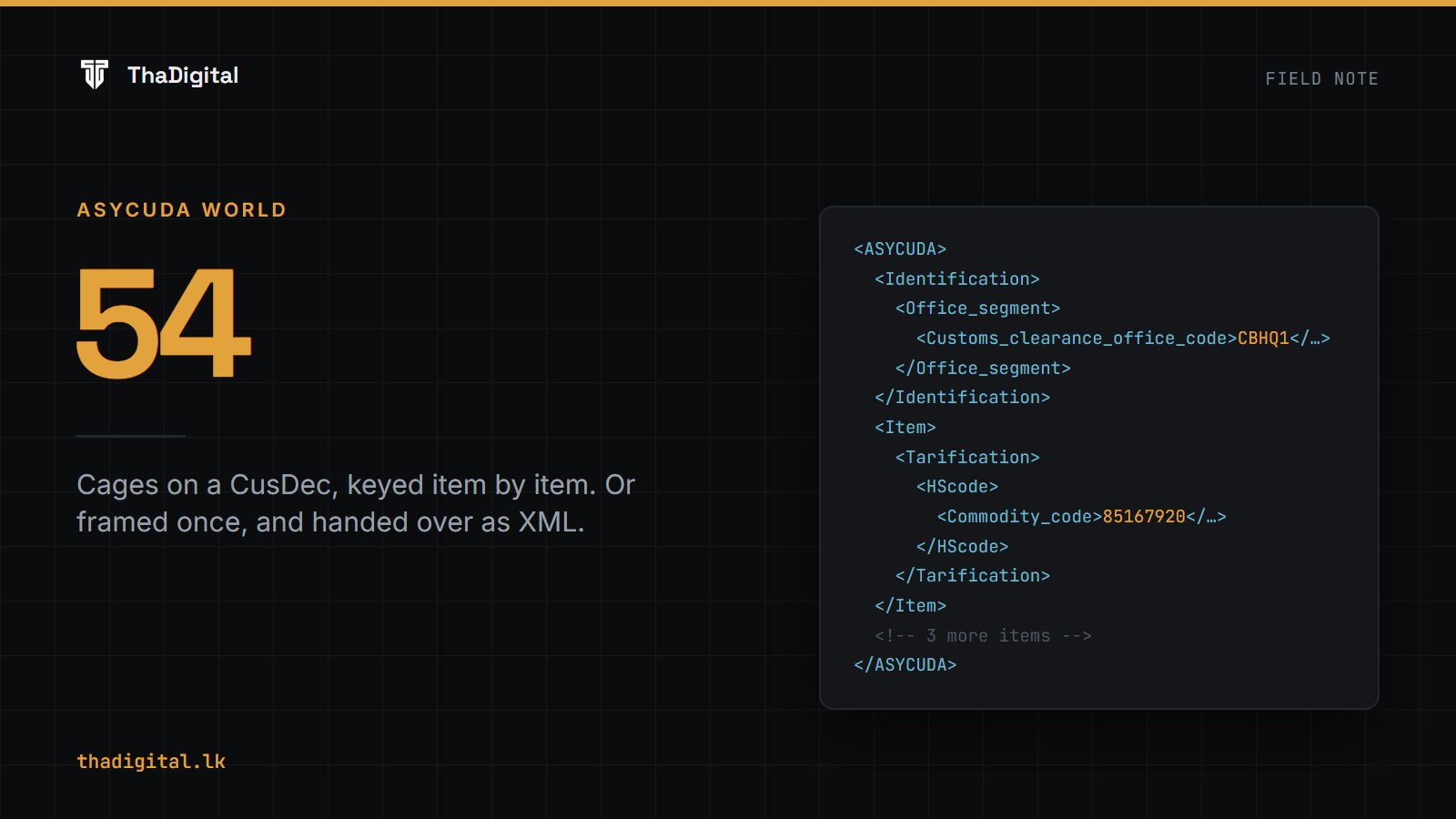
ASYCUDA World can save a declaration as an XML file and open one again. Customs' own training shows agents doing exactly that: saving an assessed CusDec as XML and bringing it back as the template for the next one.
A framing tool that writes the same XML hands over the whole framed entry at once: the header, every item, the containers and the valuation. The agent opens it in ASYCUDA, reviews it, verifies and assesses. Nothing is typed twice, and the frame and the entry are the same thing.
Why the file has to be exact
ASYCUDA is as strict about its file as it is about its cages. The structure has to match its own, segment for segment and in its own order. Coded fields have to hold codes from its own lists. And there are conventions that matter which the published message description does not spell out.
A file that is nearly right is either refused, or accepted with something quietly wrong. That is the difference between a framing tool that saves an afternoon and one that costs one.
What good framing checks, before ASYCUDA does
- Office code and model of declaration, against the procedure.
- The importer's TIN, from the client record, tallying with the BL and DO.
- Invoice value, gross and net weight, and packages, against the supplier's own totals.
- The total packages on the header equal to the sum of the items.
- Every HS code current on the declaration date, with its import control: banned, licensed, or a standards mark to arrange.
- The exchange rate from that week's Customs schedule, to four decimals.
- Every tax worked out the way Customs works it, item by item. How Customs rounds.
- Container numbers and air waybills, checked the moment they are typed.
- Units in ASYCUDA's own codes, weights in kilograms, no zeros where ASYCUDA expects a figure.
- Names and addresses that fit the space ASYCUDA gives them.
- Every cage ASYCUDA will insist on, named while it is still empty.
- The supporting documents kept with the job, ready to sign and attach.
Framing in the paperless era
Going paperless moves the documents onto a screen. It does not, on its own, remove the manual work behind them. The agencies that gain the most from 1 October are the ones whose every entry is already framed, checked and filed with its papers before anyone opens ASYCUDA.
How ClearWay does it
ClearWay is built for exactly this. The supplier's invoice comes in, every cage is worked out and checked, the duty is calculated as Customs calculates it, the papers print on A4, and the declaration is written as XML in ASYCUDA World's own format. Bring an entry you cleared last month, and see it framed in front of you.
Sources
- Sri Lanka Customs, ICT Division: Import CusDec submission in ASYCUDA World (training for customs house agents).
- Daily FT: Customs goes paperless, makes digital signatures mandatory.
- The Morning: on Customs' plans and the capacity of the current system.